
Questions? Call 800.716.7608

Help Center

Freight Terms

Define commonly used freight terms.

Solve a problem

  • What does "Haz Mat" mean?
  • Haz Mat stands for Hazardous Materials. Hazardous material is any substance or material that is considered to have the capability to cause an unreasonable risk to human health or safety or the environment when transported in commerce, used incorrectly, or if not properly stored or contained is considered a hazardous material. Hazardous materials include fuels, bio-chemicals and pharmaceuticals.
  • What does first mile mean?
  • Customers who choose to pay additional for these services have special pickup or delivery needs. First mile refers to services wherein the driver is needed for inside pickup, packaging and dismantling, stair carries and more. Final mile refers to the opposite wherein the driver is needed for inside delivery, removal of packaging materials, assembly or setup and more.
  • What does LTL mean?
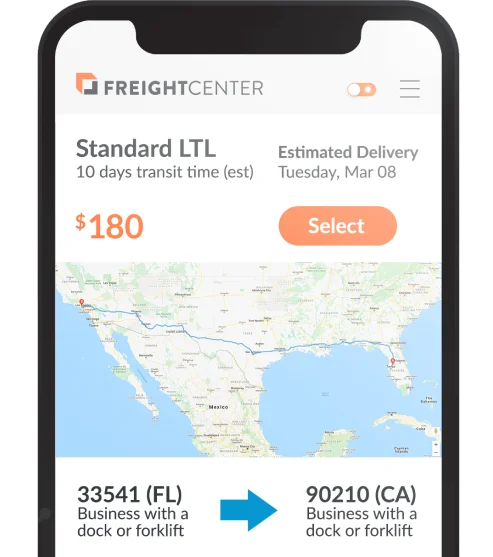
  • LTL is an acronym that stands for Less than Truckload freight. LTL freight ranges between 100 and 20,000 lbs. When the item you need shipped or transported is too large to take to a Post Office or your local parcel company, freight is seen as a more economical approach. Freight shipping is the easiest way to move large and bulky items quickly, efficiently and economically. Many commodities can be classified as LTL freight: blanket-wrapped furniture, palletized or crated appliances, motorcycles, palletized boxes, etc. If your freight weighs more than 100 lbs and does not fill a full dedicated truck, than it is likely you need to ship LTL freight. Perishables, however, require a dedicated truck for refrigeration.
  • What does NOI mean?
  • The shipping term, NOI stands for "Not Otherwise Indicated". If your package cannot be classified by the National Motor Freight Classification Association, than FreightCenter.com can manually provide a NOI class rate quote. 


    NOI shipping terms are typically quoted and processed manually through select freight carriers.

  • What does PCF mean?
  • Freight rates are determined by several different factors including package dimensions, weight, distance and freight class, as well as your package’s Pounds per Cubic Foot or PCF. Your package’s PCF is closely related to the freight class that is applied to your freight shipment. In freight terms, a low PCF will result in a higher class rating. In turn, a higher class rating corresponds to a higher cost to ship your freight.


    For example, a shipment that works out to 1.31 pound per cubic foot and weighs 100 pounds (Class 300) will be much more expensive to ship than an item that has the same weight but equates to 9.67 pounds per cubic foot (Class 100). In other words, the more space your freight occupies on a truck or in a container the more costs you will incur for transport. 


    For this reason, shippers are encouraged to make sure their weights and dimensions are accurate in order to avoid billing adjustments based on PCF and class changes. By far the most common reason for a re-bill or billing adjustment, it is also the most avoidable. Never guess or estimate dimensions and weights when shipping freight.

  • What is a blind shipment?
  • A blind shipment is when a third party controls the transport of freight but does not want the shipper or consignee to know the name of the third-party. Blind delivery is a way to drop-ship products from a seller to a customer without disclosing a third-party or warehouse location . The shipment will appear as though it came directly from the shipper to the customer. Request a blind shipping form through your booking agent.
  • What is a BOL?
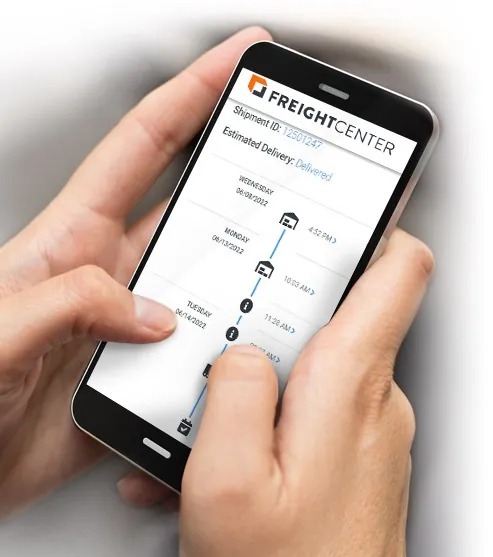
  • A Bill of Lading or BOL is standard, mandatory paperwork providing the carrier and driver with all the pertinent information related to shipping costs and transport information. This paperwork allows for proper billing to be processed by the shipping company and FreightCenter, Inc. All parties (buyer, seller and carrier) involved should have a copy of the BOL. It is very important that the FreightCenter BOL be given to the carrier at the time of pickup. The FreightCenter BOL confirms your discounted rate with the carrier.
  • What is a freight class?
  • A freight class refers to the National Motor Freight Classification (NMFC) and it is the category of your freight as defined by the NMFC. Your shipment’s freight class ultimately is what determines the total cost charged by the carrier for shipping your item. There are 18 freight class ranging from 50 (the least expensive class) to 500 (the most expensive class). You NMFC number or freight class determines your total shipping charges. For this reason, it is critical that you know the correct NMFC number in order to receive accurate freight charges and to ensure that the carrier does not re-class your shipment, which could result in a higher shipping charge. There are some commodities or combinations of transportation characteristics that have not been classified by a NMFC number. In these special cases, a Not On Index (NOI) calculation based on Pounds per Cubic Foot (PPCFT) can be used to determine the cost to ship your freight.
  • What is a freight terminal?
  • Freight terminals are hubs where different trucking lanes connect with another. By using a terminal as a pickup or delivery location, customers can lower the cost of freight shipping. Hours and carriers vary by terminal. Check hours to avoid going to a terminal when it is closed. Some terminals only open when trucks are loading and unloading. Others are open 24 hours a day.
  • What is a handling unit?
  • Cartons or packages of identical size and weight are considered one handling unit. If there is more than one package and they are of differing type, size or weight they are considered multiple handling units.

  • What is a re-bill?
  • A re-bill represents a portion of unpaid freight shipping costs as reported by the carrier. If you believe the re-bill was sent in error, please open a support ticket below.
  • What is curbside pickup?
  • If picking up from a residence or a business without a loading dock, the driver will only be responsible for curbside pickup. Generally speaking, the truck will not enter a driveway or road with limited access. Curbside pickup implies that your freight is ready for pickup when it is properly packaged and placed at the curb. Payment for any additional services like carrying boxes or pallets to the curb will be billed separately, generating a re-bill.
  • What is final mile?
  • Customers who choose to pay additional for these services have special pickup or delivery needs. First mile refers to services wherein the driver is needed for inside pickup, packaging and dismantling, stair carries and more. Final mile refers to the opposite wherein the driver is needed for inside delivery, removal of packaging materials, assembly or setup and more.
  • What is limited access?
  • Any destination or location that restricts trucks from entering a point of entry is considered to be limited access. An additional fee applies to limited access locations.
  • What is oversize?
  • Oversize freight refers to items that are longer or taller and require either flatbed truckload service or other specialty mode of transportation.
  • What is overweight?
  • Each carrier has a specific size and weight restrictions. LTL shipments typically weigh between 100 and 20,000 pounds.
  • What is white glove service?
  • White glove service is a special accessorial or added service charge used when shipping a non-traditional LTL shipment of household furniture. With this service, minimum packaging is required for transit*. White glove service includes: Inside Pickup or Delivery Shipments up to 11 pieces total or 1,500 lbs

Help topics

  • No help topics were found.

Contact Us

Still need help? Click here to contact us.

FreightCenter is hiring as part of an exciting expansion! View our careers page to learn more.