
Incoterms
Ensure smooth international shipping with FreightCenter. We provide expert guidance on Incoterms, reducing risks and costs while streamlining the experience. Call us today to speak with an expert or get a free quote online!



Incoterms in Plain English
Incoterms® , short for International Commercial Terms, are a standardized set of 11 internationally recognized trade terms, each represented by a three‑letter abbreviation in English. They set clear expectations in contracts with billing and shipping by standardizing the meaning associated with each Incoterm. This common language helps avoid misunderstandings and disputes by clarifying the responsibilities of members of the shipping agreement.





Thousands of businesses trust FreightCenter to move their freight faster, smarter, and cheaper! From unbeatable rates to top-notch service, our customers are raving about their shipping success.
See why they keep coming back!
Award-Winning Service, Trusted by Shippers Everywhere!
- 2021, 2017 & 2016 Food Logistics’ Top Green Providers
- 2021 & 2018 Supply & Demand Chain Executives’ Pros to Know: Matthew Brosious
- 2020 & 2019 Top Food Logistics’ 3PL & Cold Storage Provider Award
- 2020 & 2019 Business Observer’s Top 500 Companies on the Gulf Coast
- 2020 & 2017 SmartWay® Transport Partner
- 2020 & 2017 Food Logistics’ Champions: Rock Stars of the Supply Chain
- 2020 Best of Palm Harbor Awards for Local Businesses
- 2017 Green Supply Chain Award from Supply & Demand Chain Executive
- 2017 Tampa Bay Business Journal Heroes at Work
- 2016, 2015, & 2012 Food Logistics Top 100 Software and Technology Providers
- 2013 Tampa Bay Business 100 by Tampa Bay Business Journal
- 2013 Top 100 Great Supply Chain Partners by SupplyChainBrain
- 2012 TIA Samaritan Award Honorable Mention
- 2012, 2011 & 2010 TBBJ Fast 50 Recipient
- 2013, 2011, & 2010 Diversity Business Top Businesses
Incoterms Explained
History of Incoterms
First published in 1936, these have been regularly updated since then to reflect changes in international trade practices. The most recent version is Incoterms 2020, and they cover activities across all modes of transport, including sea, air, road, rail, and inland waterways.
Language and Abbreviations of Incoterms
The acronyms and the three-letter codes (such as FOB, CIF, DAP) are derived from English. The International Chamber of Commerce (ICC) publishes the official Incoterms rules in more than 30 languages to ensure clarity and accessibility for users around the world. This multilingual availability is important because Incoterms are a global standard, used in contracts by businesses, customs, and banks internationally.
Who Uses Incoterms?
Incoterms are used by anyone involved in the supply chain for importing or exporting goods, including:
- Exporters and importers (sellers and buyers)
- Freight forwarders
- Carriers and shipping companies
- Customs authorities and brokers
- Logistics and supply chain professionals
- Governments and banks
Their use is widespread in contracts for international business and is often required for international payments, customs clearance, and other shipping processes.
What Incoterms Cover and Do Not Cover
What Do They Cover?
Incoterms® clarify:
✔ Transport & Logistics – Who arranges/pays for shipping?
✔ Risk Ownership – When does responsibility transfer?
✔ Customs & Taxes – Who handles export/import clearance?
✔ Insurance – Who must insure the goods?
What They Do NOT Cover:
❌ Contract ownership (who owns the goods legally).
❌ Payment terms (e.g., LC, TT, advance payment).
❌ Product warranties or quality disputes.
Choosing the right Incoterm is crucial for seamless international trade, as it clearly defines the obligations of both parties, minimizing the risk of disputes and unforeseen expenses. A solid understanding of Incoterms and their proper application can significantly improve the efficiency and predictability of global shipping operations. At FreightCenter, we ensure that every detail is meticulously handled, providing you with the correct information for a smooth and hassle-free shipping experience. If you’re ready to streamline your logistics, get a free online quote or call us at 800-716-7609 to get started.
List of 11 Incoterms
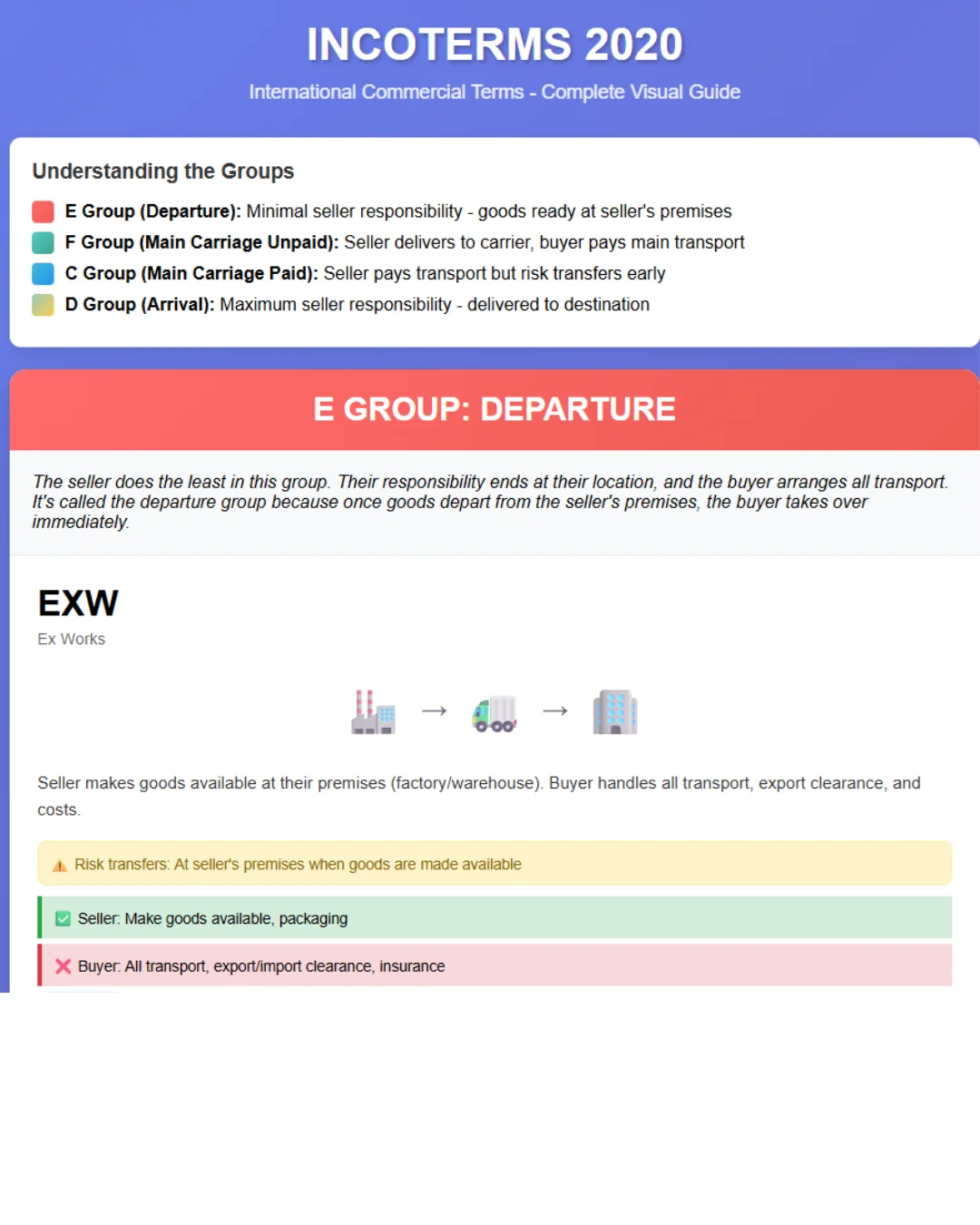
E Group: The Departure Group
The seller does the least in this group. Their responsibility ends at their location, and the buyer arranges all transport. It’s called the departure group because once goods depart from the seller’s premises, the buyer takes over immediately.
| Group | Code | Term | Definition | Mode of Transport |
|---|---|---|---|---|
| E | EXW | Ex Works | Seller makes goods available at their premises (factory/warehouse). Buyer handles all transport, export clearance, and costs. | Any mode |
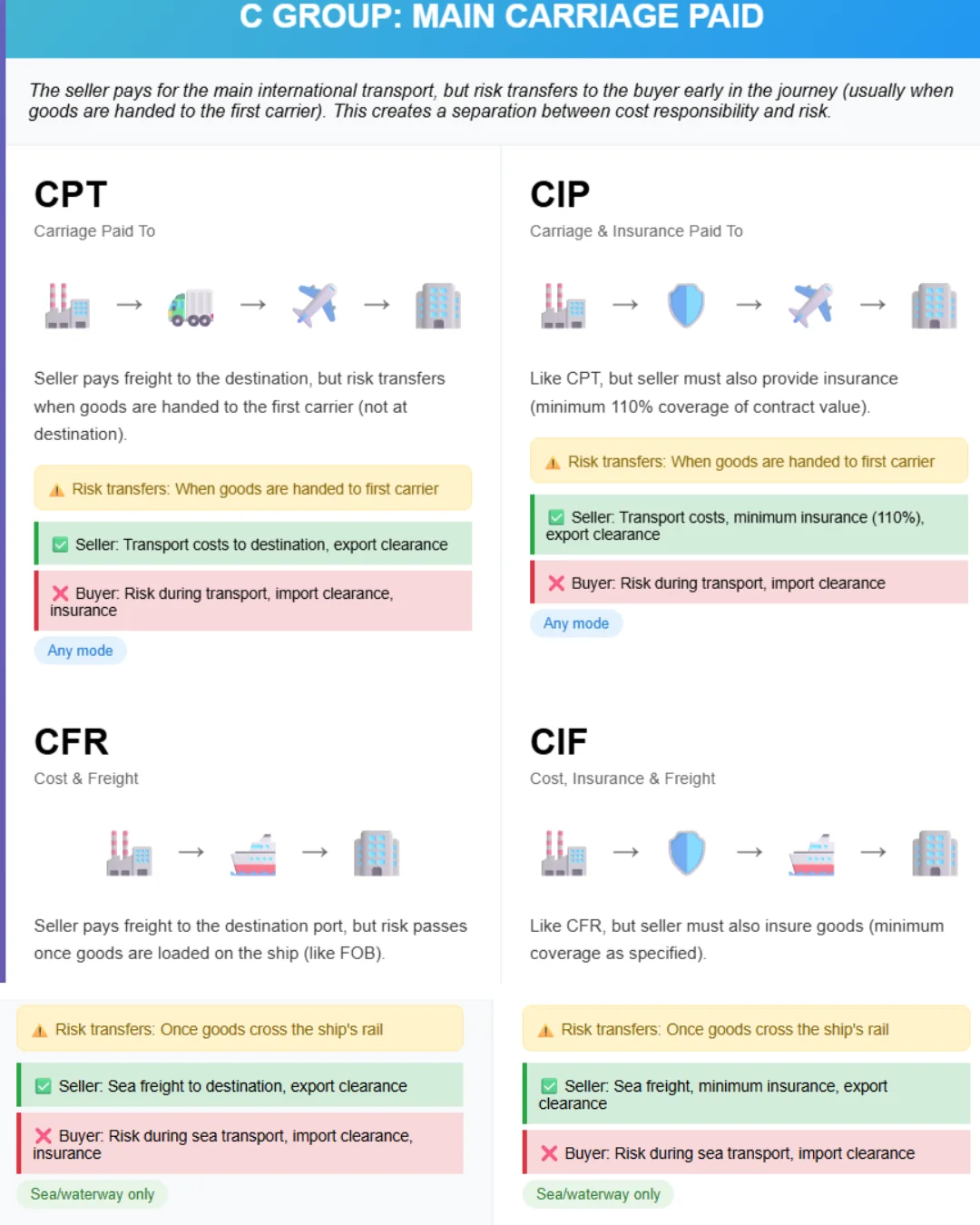
C Group – “Main Carriage Paid”
The seller pays for the main international transport to the buyer’s country, but the buyer takes on the risk once the goods are handed over to the first carrier. The seller has paid for the main leg of the trip, even though the risk passes earlier.
| Code | Term | Description | Mode of Transport |
|---|---|---|---|
| CPT | Carriage Paid To | Seller pays freight to the destination, but risk transfers when goods are handed to the first carrier (not at the destination). | Any mode |
| CIP | Carriage & Insurance Paid To | Like CPT, but the seller must also provide insurance (minimum 110% coverage). | Any mode |
| CFR | Cost & Freight | Seller pays freight to the destination port, but risk passes once goods are loaded on the ship (similar to FOB). | Sea/waterway only |
| CIF | Cost, Insurance & Freight | Like CFR, but the seller must also insure goods (minimum coverage required). | Sea/waterway only |
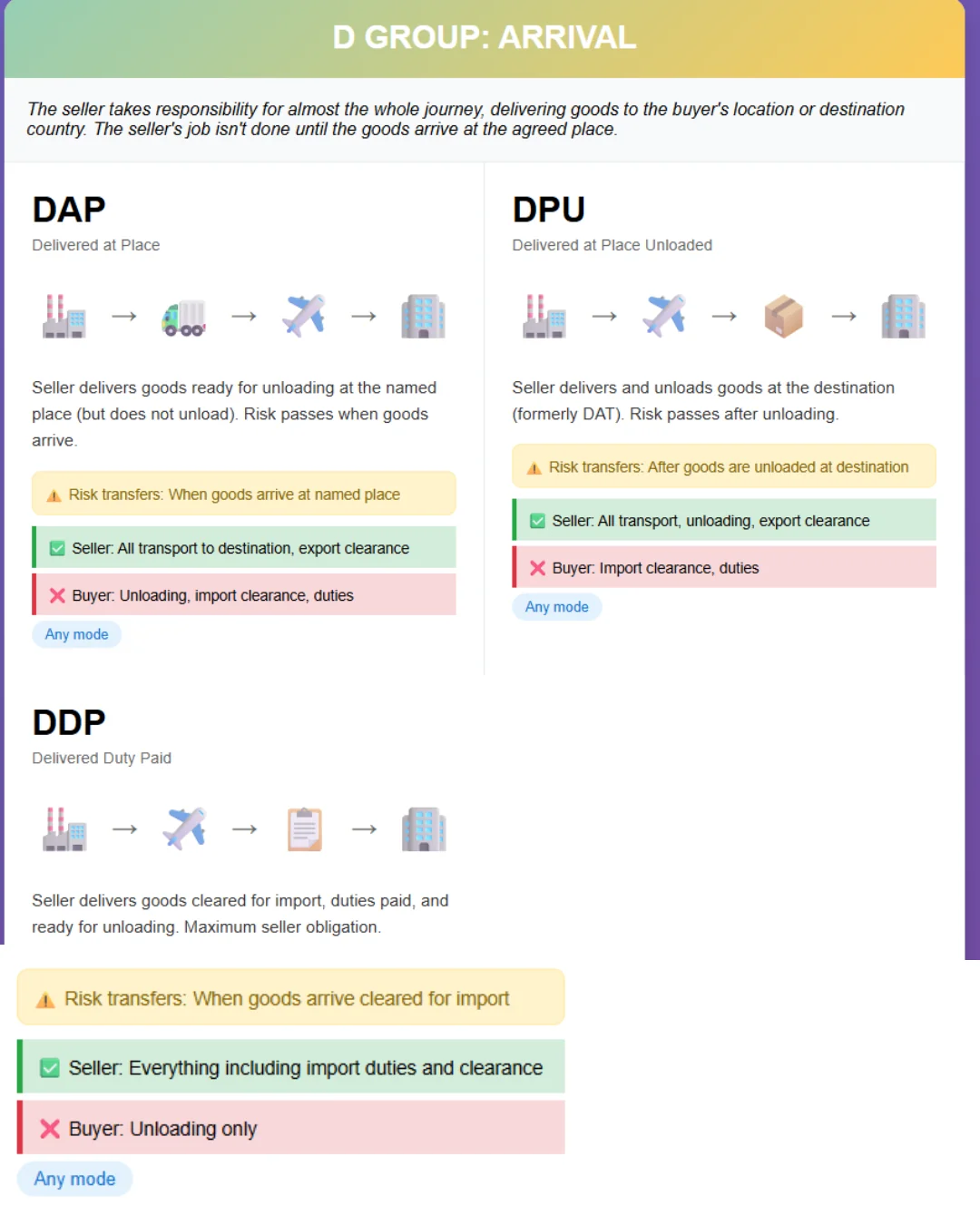
D Group – “Arrival”
The seller takes responsibility for almost the whole journey, delivering goods to the buyer’s location or destination country. The seller’s job isn’t done until the goods arrive at the agreed place.
| Code | Term | Description | Mode of Transport |
|---|---|---|---|
| DAP | Delivered at Place | Seller delivers goods ready for unloading at the named place (but does not unload). Risk passes when goods arrive. | Any mode |
| DPU | Delivered at Place Unloaded | Seller delivers and unloads goods at the destination (formerly DAT). Risk passes after unloading. | Any mode |
| DDP | Delivered Duty Paid | Seller delivers goods cleared for import, duties paid, and ready for unloading. Maximum seller obligation. | Any mode |
F Group: Main Carriage Unpaid
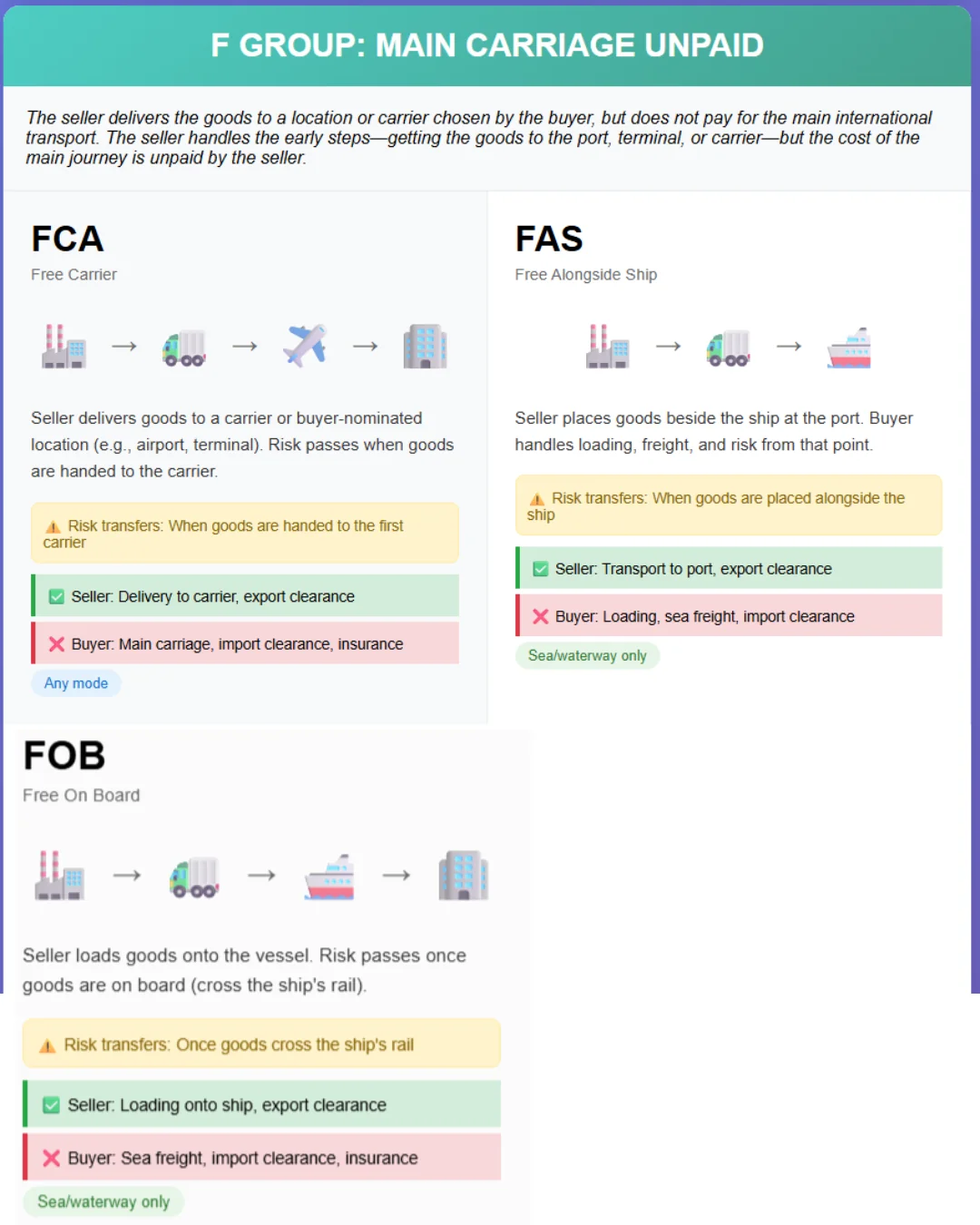
The seller delivers the goods to a location or carrier chosen by the buyer, but does not pay for the main international transport.
Why it’s called “Main Carriage Unpaid”: The seller handles the early steps—getting the goods to the port, terminal, or carrier—but the cost of the main journey is unpaid by the seller. The buyer covers the main carriage.
| Code | Term | Description | Mode of Transport |
|---|---|---|---|
| FCA | Free Carrier | Seller delivers goods to a carrier or buyer-nominated location (e.g., airport, terminal). Risk passes when goods are handed to the carrier. | Any mode |
| FAS | Free Alongside Ship | Seller places goods beside the ship at the port. Buyer handles loading, freight, and risk from that point. | Sea/waterway only |
| FOB | Free On Board | Seller loads goods onto the vessel. Risk passes once goods are on board (cross the ship’s rail). | Sea/waterway only |
To create value for our customers by delivering customized shipping solutions that meet their unique needs and to fulfill shipping demands from simple to complex with expertise, guidance and ingenuity.
Air cargo is used for goods shipped by air, usually by an air cargo service. However, it can also be sent as checked luggage on a passenger airline.
There are two types of air cargo – general and special load.
Ocean Freight is a reliable and cost-effective mode of transportation for international shipments that require large cargo ships. We offer comprehensive ocean freight solutions that provide competitive pricing, real-time tracking, and flexible shipping options to meet your specific needs. Our experienced team will handle all aspects of your ocean freight shipment.
Our Full Truckload (FTL) services for shippers looking to move large, oversized, or high-value freight. With FTL, shippers can secure an entire trailer for their freight, ensuring faster transit times and reduced risk of damage or loss. Our FTL services are cost-effective and reliable, making them an ideal choice for businesses that require full truckload shipments. Trust FreightCenter to provide customized FTL solutions tailored to your unique shipping needs.
FreightCenter offers reliable and cost-effective drayage solutions for all types of freight. Get instant quotes and compare rates from top carriers today.

 Guaranteed competitive pricing every time you ship.
Incoterm Examples
Each Incoterm has a specific meaning that can be better understood in real-life contexts. This list goes into better detail about how to understand the usage of each Incoterm.
Group E – Departure
- EXW (Ex Works): A Chinese factory sells goods EXW Shanghai, where the buyer arranges pickup and assumes all risks/costs from the factory gate.
Group F – Main Carriage Unpaid
- FCA (Free Carrier): A French cheese exporter delivers goods FCA Lyon to the buyer’s chosen trucking company, transferring risk upon handover.
- FAS (Free Alongside Ship): A Brazilian soybean seller loads goods FAS Santos Port, placing them beside the ship for the buyer to handle loading and onward shipping.
- FOB (Free On Board): An Indian textile supplier ships FOB Mumbai, loading goods onto the vessel; the buyer pays freight and bears risk afterward.
Group C – Main Carriage Paid
- CFR (Cost & Freight): A Russian oil company sells CFR Rotterdam, covering sea freight, but the risk passes to the buyer once loaded in St. Petersburg.
- CIF (Cost, Insurance & Freight): A South African diamond dealer ships CIF Antwerp, paying freight and insurance, but risk transfers at the origin port.
- CPT (Carriage Paid To): A Canadian wheat seller delivers CPT Mexico City, paying transport to the terminal, but risk shifts mid-transit.
- CIP (Carriage & Insurance Paid To): A Swiss watchmaker ships CIP to Dubai, covering transport/insurance, but the buyer assumes risk during transit.
Group D – Arrival
- DAP (Delivered At Place): A Japanese automaker delivers cars DAP Berlin, paying all costs until arrival, but the buyer handles import duties/unloading.
- DPU (Delivered at Place Unloaded): A Turkish furniture seller ships DPU to New York, unloading goods at the buyer’s warehouse, but import taxes are the buyer’s responsibility.
- DDP (Delivered Duty Paid): A U.S. tech company sells DDP Sydney, handling all costs/risks—including customs—until delivery at the buyer’s door.
Incoterms FAQ's
Q. What are Incoterms?
Incoterms, short for International Commercial Terms, are standardized trade terms used globally in sales contracts. They define the responsibilities of buyers and sellers in the shipment of goods, including who bears the cost, risk, and responsibilities at each stage of the shipping process.
Q. Why are Incoterms important in international trade?
Incoterms are crucial because they help avoid confusion by clearly outlining each party’s obligations in a transaction. This reduces the likelihood of disputes and unexpected costs, ensuring smoother and more predictable global trade operations.
Q. How do I choose the right Incoterm for my shipment?
Choosing the right Incoterm depends on several factors, including the type of goods being shipped, the destination, and your specific needs regarding cost, risk, and responsibility. Our experts at FreightCenter can help you select the most appropriate Incoterm for your shipment.
Q. How often are Incoterms updated?
Incoterms are periodically updated by the International Chamber of Commerce (ICC) to reflect changes in international trade practices. The latest version, Incoterms 2020, is currently in use, but updates are typically made every decade.
Q. Q: How do Incoterms apply to partial shipments?
Incoterms can apply to partial shipments, but it depends on how the sales contract is written. If a shipment is split into multiple deliveries, each leg may carry its own risk and cost transfer point. To avoid confusion, the contract should clearly state how Incoterms apply to each partial shipment.
Q. Q: Who pays for pre-shipment inspection costs?
The responsibility for pre-shipment inspection costs depends on:
-
The chosen Incoterm (which determines export clearance obligations).
-
Contractual agreements (parties can override default rules).
Q. Q: How do Incoterms affect customs valuation?
The chosen Incoterm affects the customs value – for example, CIF includes freight/insurance in the declared value, while FOB only includes costs up to loading. Always verify local customs rules.
Q. How do Incoterms relate to insurance?
Only 2 Incoterms Require Insurance
-
CIF (Cost, Insurance & Freight) – for sea/inland waterway transport only
-
CIP (Carriage & Insurance Paid To) – for any mode of transport
Under these two terms, the seller is obligated to purchase insurance for the buyer’s benefit. All other Incoterms leave insurance optional, meaning either party can choose to arrange it based on their risk tolerance.
In Other Incoterms, Insurance Is Optional—But Still Important
For terms like EXW, FCA, FOB, or DAP, neither party is obligated to arrange insurance under Incoterms rules. However:
-
Buyers may want to insure if they’re responsible for the goods during transit.
-
Sellers may insure if they’re liable up to the delivery point.
The party bearing the risk during a segment of the shipment should strongly consider getting insurance.
Q. Are we allowed to customize Incoterms in a contract?
A: Yes, parties can customize Incoterms as long as the modifications are clearly written into the contract.
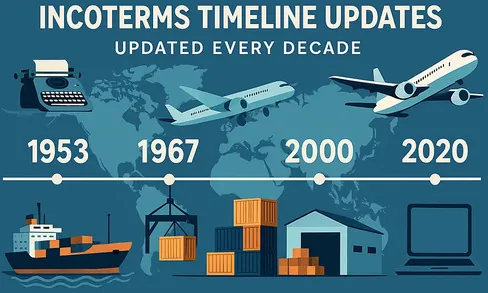
The Incoterms list is regularly updated
Incoterms are updated roughly every decade to keep pace with the changing landscape of global trade, technology, and transport. Major revisions have taken place in 1953, 1967, 1976, 1980, 1990, 2000, 2010, and 2020
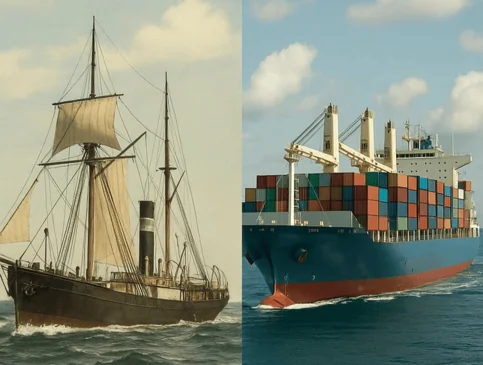
Always changing with the times
Several terms have been added and later removed over the years, like DAF (Delivered at Frontier) and DES (Delivered ex Ship), as shipping technology and practices evolve
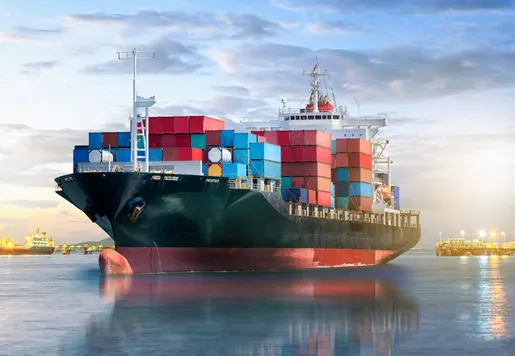
“FOB” Isn’t Always Right for Containers
FOB (Free On Board) is often misused in container shipping. It was designed for bulk cargo at seaports. For containerized freight, FCA (Free Carrier) is usually the correct term.