

Customizable TMS That Puts You in Control
Flexible, scalable, and built to fit your business, not the other way around.



Simplify your freight shipping with FreightCenter’s customizable TMS platform designed to handle weight, dimensions, pickup allocations, and more with ease.
Plan smarter, ship faster, and improve accuracy on every load. Our Transportation Management Software gives you the tools to customize shipments your way, reduce errors, and streamline the entire process from quote to delivery.





Thousands of businesses trust FreightCenter to move their freight faster, smarter, and cheaper! From unbeatable rates to top-notch service, our customers are raving about their shipping success.
See why they keep coming back!
Award-Winning Service, Trusted by Shippers Everywhere!
- 2021, 2017 & 2016 Food Logistics’ Top Green Providers
- 2021 & 2018 Supply & Demand Chain Executives’ Pros to Know: Matthew Brosious
- 2020 & 2019 Top Food Logistics’ 3PL & Cold Storage Provider Award
- 2020 & 2019 Business Observer’s Top 500 Companies on the Gulf Coast
- 2020 & 2017 SmartWay® Transport Partner
- 2020 & 2017 Food Logistics’ Champions: Rock Stars of the Supply Chain
- 2020 Best of Palm Harbor Awards for Local Businesses
- 2017 Green Supply Chain Award from Supply & Demand Chain Executive
- 2017 Tampa Bay Business Journal Heroes at Work
- 2016, 2015, & 2012 Food Logistics Top 100 Software and Technology Providers
- 2013 Tampa Bay Business 100 by Tampa Bay Business Journal
- 2013 Top 100 Great Supply Chain Partners by SupplyChainBrain
- 2012 TIA Samaritan Award Honorable Mention
- 2012, 2011 & 2010 TBBJ Fast 50 Recipient
- 2013, 2011, & 2010 Diversity Business Top Businesses

What Is a Customizable TMS Platform?
A Transportation Management System (TMS) is a digital solution designed to simplify logistics operations like planning, executing, and monitoring freight shipments. It gives users real-time visibility, cost control, and data-driven insights to drive efficiency.
FreightCenter takes this further by combining its TMS with the value and flexibility of a third-party logistics provider (3PL):
-
You get expert guidance, access to a vast network of carriers, and end-to-end support—from onboarding to daily usage at FreightCenter.
-
FreightCenter’s TMS integrates with systems like ERP, WMS, CRM, and accounting tools, facilitating seamless workflow across different departments FreightCenter.
7 Ways Transportation Management Systems Transform Your Supply Chain
In today’s competitive logistics landscape, Transportation Management Systems (TMS) have become essential tools for businesses looking to optimize their shipping operations, reduce costs, and improve customer satisfaction. Whether you’re a small business shipping a few packages weekly or a large enterprise managing complex multimodal transportation networks, understanding TMS benefits is crucial for making informed supply chain decisions.
1. Significant Cost Savings Through Smart Optimization
Cost reduction remains the primary driver for TMS adoption, and for good reason. Modern TMS platforms deliver savings through multiple channels:
Rate Shopping and Carrier Comparison
Instead of manually calling carriers for quotes, TMS software automatically compares rates across your entire carrier network. This real-time rate shopping ensures you’re always getting competitive pricing, whether shipping a single package or a full truckload.
Shipment Consolidation Opportunities
Smart algorithms identify consolidation opportunities that human planners might miss. By combining multiple smaller shipments into fewer, larger loads, businesses reduce per-unit shipping costs and improve trailer utilization rates.
Route Optimization
Advanced routing algorithms consider factors like traffic patterns, fuel costs, driver hours-of-service regulations, and delivery time windows to create the most cost-effective routes. This optimization typically reduces miles driven by 10-20%.
Freight Audit and Payment Accuracy
Automated freight auditing catches billing errors, duplicate charges, and unauthorized accessorial fees. Studies show that 3-5% of freight invoices contain errors, making this feature alone worth significant savings.
2. Enhanced Visibility and Real-Time Tracking
The Transparency Advantage: More than 80% of shippers report improved customer satisfaction after implementing TMS tracking capabilities.
Modern supply chains demand visibility, and TMS platforms deliver unprecedented transparency throughout the shipping process.
End-to-End Shipment Tracking
Real-time GPS tracking, carrier integration, and automated status updates provide complete visibility from pickup to delivery. This transparency helps identify potential delays before they impact customers and enables proactive communication.
Centralized Dashboard Management
Instead of logging into multiple carrier websites or making phone calls for updates, TMS dashboards consolidate all shipment information in one location. Operations teams can monitor hundreds of shipments simultaneously through intuitive, customizable interfaces.
Exception Management and Alerts
Automated alerts notify teams when shipments deviate from planned schedules, routes, or delivery windows. This early warning system enables quick problem resolution and helps maintain customer service commitments.
Performance Analytics and KPIs
Built-in reporting tracks key performance indicators like on-time delivery rates, average transit times, and carrier performance scores. These metrics provide actionable insights for continuous improvement.
3. Dramatic Efficiency and Time Savings
The Productivity Boost: TMS automation reduces shipping administration time by 60-80%, freeing staff for higher-value activities.
Transportation management involves numerous time-consuming manual tasks that TMS platforms can automate or streamline.
Automated Carrier Selection
Rather than manually evaluating carriers for each shipment, TMS software applies predefined rules and algorithms to select optimal carriers based on cost, service level, geographic coverage, and performance history.
Streamlined Load Tendering
Electronic load tendering eliminates phone calls and emails, automatically sending shipment details to carriers and managing acceptance/rejection responses. This process reduces booking time from hours to minutes.
Digital Documentation Management
Bills of lading, shipping labels, customs documentation, and delivery receipts are generated automatically with accurate information pulled from integrated systems. This eliminates manual data entry and reduces documentation errors.
Automated Scheduling and Appointments
Integration with carrier systems enables automatic pickup scheduling and delivery appointment setting, reducing coordination time and improving resource utilization.
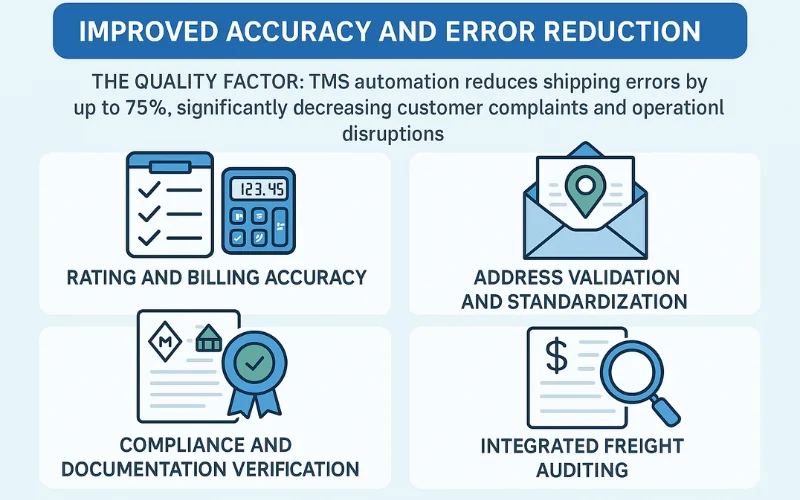
4. Improved Accuracy and Error Reduction
The Quality Factor: TMS automation reduces shipping errors by up to 75%, significantly decreasing customer complaints and operational disruptions.
Human error in transportation management can be costly, leading to service failures, billing disputes, and customer dissatisfaction. TMS platforms address this challenge through comprehensive automation and validation.
Rating and Billing Accuracy
Automated rating engines apply correct tariffs, fuel surcharges, and accessorial charges based on real-time carrier data. This precision eliminates manual calculation errors and reduces billing disputes.
Address Validation and Standardization
Built-in address validation tools verify and standardize shipping addresses, reducing delivery failures and return shipments. This feature is particularly valuable for e-commerce businesses handling high volumes of residential deliveries.
Compliance and Documentation Verification
TMS platforms ensure regulatory compliance by validating hazmat classifications, weight restrictions, and required documentation. This automated verification reduces the risk of violations and associated penalties.
Integrated Freight Auditing
Pre-payment freight auditing compares invoices against negotiated rates and shipment details, catching discrepancies before payment. This process typically identifies 2-4% savings on freight spend through error correction.
5. Scalability and Business Growth Flexibility
The Growth Enabler: TMS platforms can handle 10x shipment volume increases without proportional staff additions, supporting business expansion efficiently.
As businesses grow, transportation complexity increases exponentially. TMS platforms provide the scalability needed to handle growth without overwhelming operational teams.
Volume Handling Capabilities
Cloud-based TMS solutions can process thousands of shipments daily without performance degradation. This scalability ensures consistent service levels as business volumes fluctuate or grow.
Multi-Location and Multi-Modal Support
Modern TMS platforms support complex transportation networks including multiple distribution centers, various transportation modes (LTL, FTL, parcel, intermodal), and international shipping requirements.
Carrier Network Expansion
As businesses enter new markets or require additional capacity, TMS platforms can quickly onboard new carriers and integrate them into existing workflows. This flexibility supports geographic expansion and seasonal capacity needs.
Configurable Business Rules
Flexible rule engines allow businesses to modify carrier selection criteria, routing preferences, and service level requirements without system reconfiguration. This adaptability supports changing business strategies and market conditions.
6. Superior Customer Service and Communication
The Satisfaction Multiplier: Companies using TMS platforms report 25% improvement in customer satisfaction scores related to shipping and delivery.
Customer expectations for shipping transparency and reliability continue to rise. TMS platforms provide tools needed to exceed these expectations consistently.
Instant Quote Generation
Customer service representatives can generate accurate shipping quotes in real-time, considering multiple carriers and service options. This capability enables faster response times and more competitive pricing discussions.
Proactive Communication Tools
Automated notifications keep customers informed about shipment status, potential delays, and delivery confirmations. These proactive updates reduce customer inquiries and demonstrate service commitment.
Accurate Delivery Commitments
Advanced transit time calculations consider carrier performance history, route complexity, and seasonal factors to provide realistic delivery estimates. This accuracy helps set proper customer expectations and reduces service failures.
Self-Service Tracking Portals
Customer portals provide 24/7 access to shipment tracking, delivery confirmation, and shipping history. This self-service capability improves customer satisfaction while reducing call center volume.
7. Data-Driven Decision Making and Strategic Insights
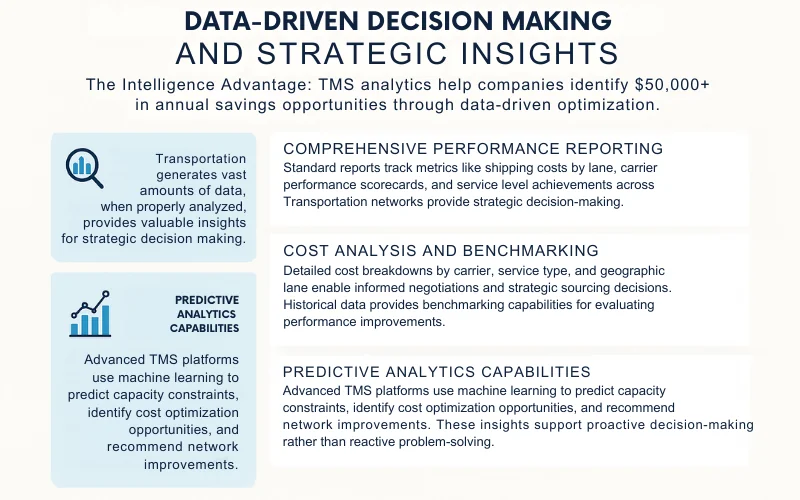
The Intelligence Advantage: TMS analytics help companies identify $50,000+ in annual savings opportunities through data-driven optimization.
Transportation generates vast amounts of data that, when properly analyzed, provides valuable insights for strategic decision-making.
Comprehensive Performance Reporting
Standard reports track metrics like shipping costs by lane, carrier performance scorecards, and service level achievements. These reports identify trends and improvement opportunities across the transportation network.
Cost Analysis and Benchmarking
Detailed cost breakdowns by carrier, service type, and geographic lane enable informed negotiations and strategic sourcing decisions. Historical data provides benchmarking capabilities for evaluating performance improvements.
Predictive Analytics Capabilities
Advanced TMS platforms use machine learning to predict capacity constraints, identify cost optimization opportunities, and recommend network improvements. These insights support proactive decision-making rather than reactive problem-solving.
Custom Dashboard Creation
Configurable dashboards allow different stakeholders to access relevant metrics and KPIs. Executives can monitor high-level trends while operations teams focus on daily performance indicators.
Key Components of a Customizable TMS Platform
1. Shipment Management
The core of any TMS is its ability to manage shipments. Users can enter details such as weight, dimensions, pickup locations, and delivery requirements. Customization allows shippers to tailor these fields to their unique freight needs, ensuring accurate data every time.
2. Rate & Carrier Management
A customizable TMS integrates with multiple carriers, providing instant rate comparisons. Businesses can prioritize preferred carriers, negotiate contract rates, and set rules for selecting the most cost-effective option.
3. Route Optimization
The platform uses algorithms to determine the most efficient routes. Custom settings may account for delivery windows, mode selection (LTL, FTL, intermodal), or accessorial requirements, reducing both transit time and cost.
4. Order & Inventory Integration
Customizable TMS platforms often integrate with ERP, WMS, or e-commerce systems. This ensures that freight booking aligns seamlessly with order fulfillment and inventory control.
5. Tracking & Visibility
Real-time shipment tracking is a must. Dashboards can be customized to show updates, exception alerts, and KPIs most relevant to the business. This helps improve decision-making and customer communication.
6. Reporting & Analytics
Data-driven insights are essential for cost savings and efficiency. A customizable TMS lets businesses set custom KPIs, create tailored reports, and analyze trends to continuously improve logistics performance.
7. Billing & Documentation
From bills of lading to invoices, customizable modules ensure documentation matches a company’s processes. Automating paperwork reduces errors and administrative burden.
8. User Roles & Access Control
Customizable platforms allow businesses to define user roles, permissions, and workflows. This ensures the right people have access to the right features, improving security and efficiency.
9. Scalability & Flexibility
A strong TMS adapts as the business grows—supporting new shipping modes, regions, or compliance requirements. Custom modules make it easy to add or remove functionality over time.
At FreightCenter, our customizable Transportation Management System (TMS) is built to adapt to your freight strategy—whether you’re moving small parcels or managing large-scale logistics operations. With 25+ years of experience, we offer finely-tuned solutions that support a range of shipping modes and scenarios, all backed by expert guidance and our nationwide carrier network.
Perfect for smaller loads that don’t require a full truck, our TMS streamlines Less-than-Truckload shipping with automated rate comparisons, and optimized routing. You’ll gain real-time visibility and save costs by only paying for the space you need.
For larger or high-volume shipments, our platform simplifies full truckload shipping with access to dry vans, flatbeds, refrigerated trailers, and more.
When time is critical, a TMS helps you move fast. Tap into team-driver solutions, guaranteed delivery windows, and real-time tracking.
Handling port pickups, rail-to-truck transfers, and final-mile delivery is no small task. A TMS makes it easier to manage drayage and intermodal moves with centralized scheduling, port coordination, and visibility from dock to destination.

 Guaranteed competitive pricing every time you ship.

Start Smarter Shipping with a Customizable TMS
Our team will guide you through setup, configuration, and best practices. You don’t need to be a developer. You just need better shipping tools.
🔹 Use our free freight quote tool
🔹 Call (800) 716-7608 to speak with a shipping expert
Customizable TMS: Frequently Asked Questions
Q. What is a TMS platform?
A Transportation Management System (TMS) is logistics software that helps businesses plan, execute, and optimize the movement of freight. It manages carrier selection, route planning, load booking, real-time tracking, and freight auditing.
Q. Is TMS a CRM system?
No, a TMS (Transportation Management System) is not a CRM (Customer Relationship Management) system.
- A TMS is built to manage the planning, execution, and optimization of freight transportation. It handles things like carrier selection, rate shopping, shipment tracking, and freight auditing.
- A CRM is designed to manage customer interactions, sales pipelines, and service relationships. It’s about people and sales, not freight.
That said, many businesses integrate TMS + CRM (and sometimes ERP) so sales teams and logistics teams can share data. For example, a sales rep in the CRM could see delivery status from the TMS without leaving their dashboard.
Q. Who uses a TMS?
A TMS (Transportation Management System) is used by almost anyone who ships, manages, or moves freight. The main groups include:
Q. What are the main benefits of a TMS?
Typical benefits include cost savings, better shipment visibility, faster carrier selection, and streamlined paperwork.
Q. Does a TMS work for both small and large companies?
Yes. Modern TMS platforms are built to scale with the size of a business. Small and mid-sized companies often choose cloud-based TMS solutions that are easy to set up, cost-effective, and provide instant access to carrier networks and rate comparisons. Larger enterprises typically need more advanced features—such as multi-location management, global shipping capabilities, and custom integrations with ERP and WMS systems. Because most platforms are modular, businesses of any size can adopt the level of functionality they need and expand as their shipping volume grows.
Q. Can a TMS handle all types of freight?
Most modern TMS platforms are built to manage a wide range of freight types and shipping modes. Common options include LTL (less-than-truckload), FTL (full truckload), parcel, intermodal, and ocean or air freight. Many systems can also accommodate specialized needs like temperature-controlled shipments, oversized equipment, or hazardous materials, though these sometimes require add-on modules or carrier integrations. The flexibility of a TMS depends on the provider, but in general, it can manage everything from small parcel deliveries to complex international supply chains.
Q. How does a TMS save money?
A TMS reduces costs in several ways. It allows businesses to compare carrier rates side by side, ensuring they choose the most cost-effective option for each shipment. It also helps with route optimization and shipment consolidation, which cuts down on fuel and transportation expenses. By automating paperwork and auditing freight bills, a TMS minimizes billing errors and overcharges. Over time, the reporting and analytics features highlight trends and inefficiencies, so companies can negotiate better contracts and continuously improve their logistics strategy.
Q. Is a TMS the same as an ERP system?
No. A TMS (Transportation Management System) and an ERP (Enterprise Resource Planning system) are different, but they often work together. A TMS is specialized software for managing freight—things like carrier selection, shipment tracking, and freight auditing. An ERP, on the other hand, is a broad business management system that covers finance, HR, manufacturing, inventory, and more. Many companies integrate their TMS with their ERP so transportation data flows seamlessly into overall business operations.
Q. Does a TMS integrate with other systems?
Yes. Many integrate with ERP, WMS (Warehouse Management System), CRM, and accounting platforms.
Q. What industries benefit most from a TMS?
Retail, manufacturing, distribution, e-commerce, food and beverage, healthcare, and virtually any sector that ships goods.
Q. Is a TMS system secure?
Yes. Reputable TMS platforms are designed with security in mind. They typically use data encryption, secure logins, role-based access controls, and industry compliance standards (such as SOC 2 or ISO certifications) to protect sensitive logistics and financial information. Many also provide audit trails and secure integrations with ERP, WMS, and accounting systems to keep your data safe throughout the supply chain.
Why Use a Customizable TMS Platform

Seamless Integration
Customizable software integrates with ERP, WMS, and accounting platforms, ensuring your freight data works in sync with the rest of your business systems.

Scalability for Any Business Size
Whether you’re a small business shipping a few pallets or an enterprise managing nationwide freight, customizable software adapts to your needs—scaling as you grow.

Cost Savings Through Optimization
By accurately classifying shipments and consolidating freight when possible, customizable TMS platforms help shippers avoid costly reclassifications and accessorial fees.