

What Is a Certificate of Origin?
Certificate of Origin for International Freight Shipping
A certificate of origin is a document that identifies where a product was made, produced, or manufactured. It may be required for customs clearance, duty rates, trade agreement claims, or import eligibility when goods move across borders.
If you are shipping internationally, FreightCenter can help you compare freight options and understand what shipment details you may need before booking.



What Is a Certificate of Origin?
A certificate of origin, often called a CO or COO, is a trade document that states the country where goods were made, produced, or manufactured. Customs authorities may use it to help determine duties, taxes, trade agreement eligibility, and whether the goods can legally enter the destination country.
A certificate of origin does not replace other international shipping documents, such as a commercial invoice, packing list, bill of lading, or customs declaration. Depending on the shipment, several documents may be needed before freight can clear customs.
Customs authorities may use a certificate of origin to help determine:
- Duty and tariff rates
- Trade agreement eligibility
- Import restrictions
- Whether goods can legally enter a country
- Whether a shipment needs further review





Thousands of businesses trust FreightCenter to move their freight faster, smarter, and cheaper! From unbeatable rates to top-notch service, our customers are raving about their shipping success.
See why they keep coming back!
Award-Winning Service, Trusted by Shippers Everywhere!
- 2021, 2017 & 2016 Food Logistics’ Top Green Providers
- 2021 & 2018 Supply & Demand Chain Executives’ Pros to Know: Matthew Brosious
- 2020 & 2019 Top Food Logistics’ 3PL & Cold Storage Provider Award
- 2020 & 2019 Business Observer’s Top 500 Companies on the Gulf Coast
- 2020 & 2017 SmartWay® Transport Partner
- 2020 & 2017 Food Logistics’ Champions: Rock Stars of the Supply Chain
- 2020 Best of Palm Harbor Awards for Local Businesses
- 2017 Green Supply Chain Award from Supply & Demand Chain Executive
- 2017 Tampa Bay Business Journal Heroes at Work
- 2016, 2015, & 2012 Food Logistics Top 100 Software and Technology Providers
- 2013 Tampa Bay Business 100 by Tampa Bay Business Journal
- 2013 Top 100 Great Supply Chain Partners by SupplyChainBrain
- 2012 TIA Samaritan Award Honorable Mention
- 2012, 2011 & 2010 TBBJ Fast 50 Recipient
- 2013, 2011, & 2010 Diversity Business Top Businesses

Why Is a Certificate of Origin Important?
A certificate of origin helps customs officials identify where imported goods came from. This matters because the country of origin can affect duty rates, tariff treatment, and whether the product qualifies for a trade agreement.
A certificate of origin may be needed to:
- Prove where a product was made
- Support customs clearance
- Help determine duties or tariffs
- Claim reduced duties under a trade agreement
- Confirm whether goods can be imported
- Meet buyer, bank, customs broker, or government requirements
If the certificate of origin is missing, incomplete, or wrong, the shipment may be delayed, rejected, or charged higher duties.
Types of Certificates of Origin
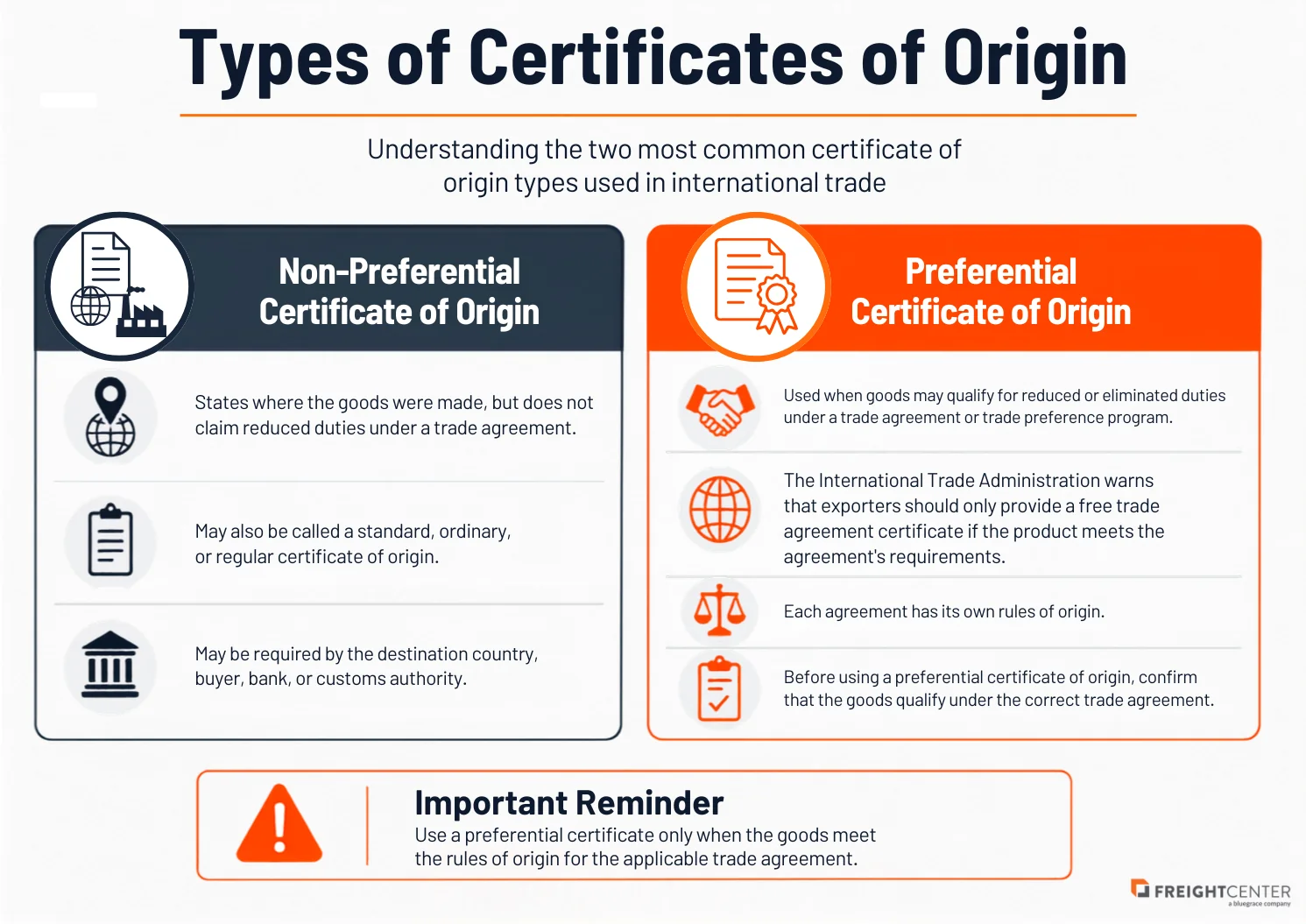
There are two common types of certificates of origin: non-preferential and preferential.
Non-Preferential Certificate of Origin
A non-preferential certificate of origin states where the goods were made, but it does not claim reduced duties under a trade agreement.
This may also be called a standard, ordinary, or regular certificate of origin. It may be required by the destination country, buyer, bank, or customs authority.
Preferential Certificate of Origin
A preferential certificate of origin is used when goods may qualify for reduced or eliminated duties under a trade agreement or trade preference program.
The International Trade Administration warns that exporters should only provide a free trade agreement certificate if the product meets the agreement’s requirements, because each agreement has its own rules of origin.
Before using a preferential certificate of origin, confirm that the goods qualify under the correct trade agreement.
What Information Is Included on a Certificate of Origin?
A certificate of origin may vary by country, trade agreement, or issuing organization. In many cases, it includes details about the exporter, importer, product, and shipment.
Common certificate of origin details include:
- Exporter name and address
- Importer or consignee name and address
- Country of origin
- Country of destination
- Product description
- Harmonized System code, if required
- Quantity or unit count
- Shipment weight
- Invoice number
- Transport details
- Declaration statement
- Authorized signature or stamp
The information should match the shipment’s commercial invoice, packing list, and other customs documents.
International shipping may involve more than one freight service. FreightCenter helps shippers compare options based on shipment size, destination, budget, deadline, and handling needs.
FreightCenter helps shippers compare international freight options for goods moving across borders or overseas. This can include air freight, ocean freight, truckload to port, cross-border freight, and other services based on the shipment.
Ocean freight is often used for larger international shipments, containerized goods, and less time-sensitive cargo. It can be a cost-effective option for overseas freight when timing is flexible.
Air freight may be a better fit when international cargo needs to move quickly. It is often used for urgent, high-value, lightweight, or time-sensitive shipments.
Domestic freight may be needed before or after an international shipment, such as moving goods to a port, warehouse, freight forwarder, or final delivery location. FreightCenter helps compare LTL and truckload options for these moves.

 Guaranteed competitive pricing every time you ship.

Ship International Freight With the Right Details
A certificate of origin helps show where goods were made, but it is only one part of international shipping. Accurate shipment details, correct paperwork, and the right freight service all matter when goods move across borders.
Before you book, confirm what documents are required for your product and destination. Then use FreightCenter to compare freight options and get your shipment moving.
Ready to ship internationally?
Certificate of Origin FAQ
Q. What is a certificate of origin?
A certificate of origin is a trade document that states where goods were made, produced, or manufactured. Customs authorities may use it to review duties, taxes, trade agreement claims, and import eligibility.
Q. What does CO or COO mean in shipping?
CO and COO both commonly refer to a certificate of origin. This document identifies the country of origin for goods moving in international trade.
Q. Is a certificate of origin required for international shipping?
Not always. Some countries, products, buyers, banks, or trade agreements require a certificate of origin, while others may not. Shippers should confirm requirements before booking international freight.
Q. Who issues a certificate of origin?
A certificate of origin may be prepared by the exporter, manufacturer, supplier, or authorized party. In some cases, it must be certified by a chamber of commerce or an approved electronic provider.
Q. Who fills out a certificate of origin?
The exporter, manufacturer, supplier, or another authorized party usually completes the certificate of origin. The party completing it should have accurate information about where the goods were made and whether they qualify for any trade agreement benefits.
Q. What is the difference between a certificate of origin and a commercial invoice?
A certificate of origin shows where the goods were made. A commercial invoice shows transaction details, including buyer, seller, value, quantity, payment terms, and product description. Many international shipments need both.
Q. What is a preferential certificate of origin?
A preferential certificate of origin is used when goods may qualify for reduced or eliminated duties under a trade agreement or trade preference program.
Q. What is a non-preferential certificate of origin?
A non-preferential certificate of origin states the country of origin but does not claim reduced duties under a trade agreement. It is often used for standard customs documentation.
Q. What information is needed for a certificate of origin?
A certificate of origin may include exporter and importer details, country of origin, destination country, product description, HS code, quantity, invoice number, weight, and an authorized signature or stamp.
Q. Can a certificate of origin reduce duties?
A certificate of origin may help support reduced duties if the goods qualify under a trade agreement or preference program. It does not automatically guarantee reduced duties.
Q. What happens if a certificate of origin is wrong?
An incorrect certificate of origin may cause customs delays, rejected entry, added duties, penalties, or requests for corrected documents.
Q. Is a certificate of origin the same as a bill of lading?
No. A certificate of origin shows where goods were made. A bill of lading is a transportation document used to identify the shipment, carrier, shipper, consignee, and freight movement details.
Q. Is country of origin the same as country of export?
Not always. Country of origin refers to where the goods were made, produced, or substantially transformed. Country of export refers to where the goods are shipped from.
Q. Do I need a certificate of origin for USMCA?
Some shipments claiming USMCA benefits may need a certification of origin or required origin data. USTR notes that the USMCA entered into force on July 1, 2020, replacing NAFTA. Shippers should confirm the current requirements with their customs broker or trade compliance expert.