

Dimensional Weight
Find out how FreightCenter carriers utilize dimensional weight instead of freight class to determine your cost to ship.



If you’ve ever been surprised by a shipping quote that seemed higher than expected, dimensional weight is probably the reason. It’s a calculation used by carriers to price shipments based not just on how much they weigh, but on how much space they take up in a truck. Understanding dimensional weight, or “DIM weight,” helps shippers avoid costly surprises and plan more accurately.





Thousands of businesses trust FreightCenter to move their freight faster, smarter, and cheaper! From unbeatable rates to top-notch service, our customers are raving about their shipping success.
See why they keep coming back!
Award-Winning Service, Trusted by Shippers Everywhere!
- 2021, 2017 & 2016 Food Logistics’ Top Green Providers
- 2021 & 2018 Supply & Demand Chain Executives’ Pros to Know: Matthew Brosious
- 2020 & 2019 Top Food Logistics’ 3PL & Cold Storage Provider Award
- 2020 & 2019 Business Observer’s Top 500 Companies on the Gulf Coast
- 2020 & 2017 SmartWay® Transport Partner
- 2020 & 2017 Food Logistics’ Champions: Rock Stars of the Supply Chain
- 2020 Best of Palm Harbor Awards for Local Businesses
- 2017 Green Supply Chain Award from Supply & Demand Chain Executive
- 2017 Tampa Bay Business Journal Heroes at Work
- 2016, 2015, & 2012 Food Logistics Top 100 Software and Technology Providers
- 2013 Tampa Bay Business 100 by Tampa Bay Business Journal
- 2013 Top 100 Great Supply Chain Partners by SupplyChainBrain
- 2012 TIA Samaritan Award Honorable Mention
- 2012, 2011 & 2010 TBBJ Fast 50 Recipient
- 2013, 2011, & 2010 Diversity Business Top Businesses

We make your freight logistics easier by offering:
-
Access to 50+ vetted carriers across truckload, LTL, intermodal, and expedited networks
-
Technology that integrates with your supply chain to provide quotes, bookings, and tracking
-
Nationwide and cross-border shipping to stores, warehouses, and DCs
-
Shipment tracking and performance analytics for better visibility and planning
-
A dedicated team of logistics experts familiar with retail challenges and timelines
What Is Dimensional Weight?
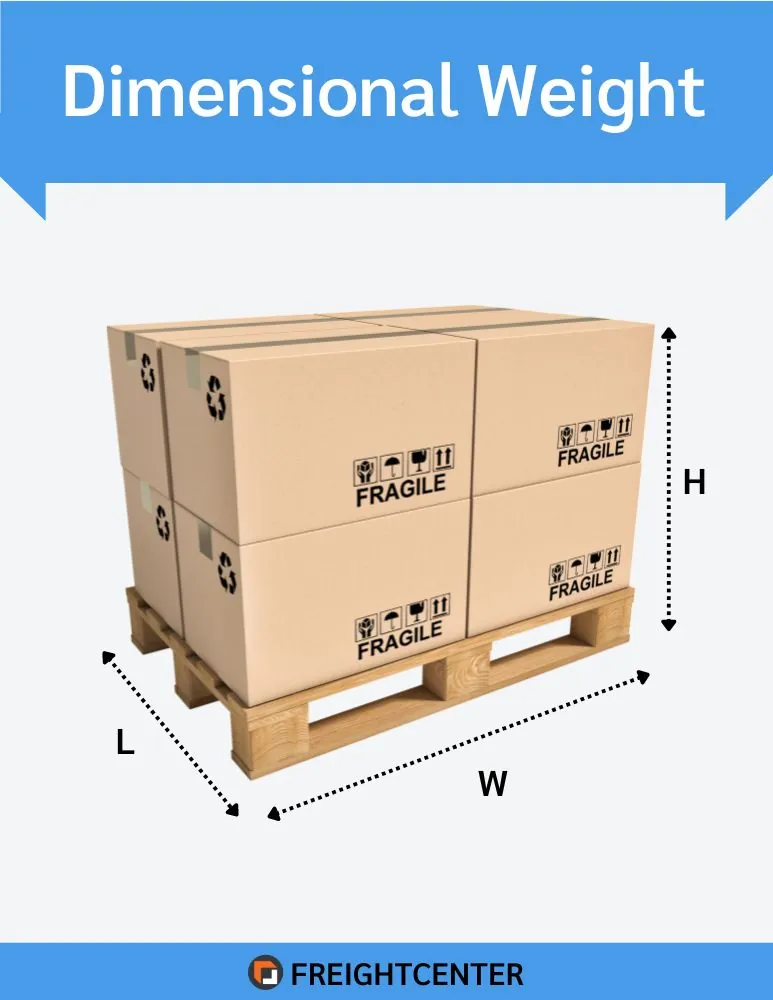
Dimensional weight is a standard formula used throughout the freight industry. It is a formula that considers a shipment’s density when determining charges. Transportation charges are based on one of two factors: the gross weight of the shipment or the dimensional weight. Whichever of the two is greater will often be the applied charges. Simply put, dimensional weight is when the weight is less than the actual size of the package—for example, a box filled with inflated basketballs.
Commercial freight services often use dimensional weight charges. Companies such as the US Postal Service may use an estimated weight based on a box’s height, length, and width. Most freight shipping services originated by charging services based on weight only. Lightweight large items were not profitable under this pricing structure. This caused the industry to create a dimensional freight pricing structure. Most carrier companies worldwide have adopted some form of dimensional weight calculations. To find out what carriers use for their specific calculation, visit their website. Use smaller boxes to avoid being penalized by dimensional weight charges. Do not risk packaging or damage to your shipped items by using too small a package.
When Do Dimensional Weight Charges Apply?
When the actual weight of a package is less than the calculated dimensional weight, carriers may charge by the dimensional weight or the actual weight. Each carrier will have different guidelines for when dimensional charges may apply. Our freight agents can help you select the best methods or offer leading industry advice to help.
To create value for our customers by delivering customized shipping solutions that meet their unique needs and to fulfill shipping demands from simple to complex with expertise, guidance and ingenuity.
Less than truckload (LTL) shipping is a smart logistics solution for businesses with smaller shipments. It combines multiple smaller shipments into a single truckload, optimizing space and reducing costs. LTL shipping offers affordability and efficiency while ensuring timely delivery, making it an ideal choice for companies looking to save on transportation expenses without compromising on service quality.
Expedited shipping is a premium service designed to meet urgent delivery needs. It prioritizes speed and quick turnaround, ensuring that packages or goods reach their destination faster than standard shipping options. Expedited shipping is the go-to choice when time-sensitive deliveries are essential, providing businesses and individuals with reliable and prompt service for critical shipments.
Short-distance. Big impact. Drayage connects the dots between ports, rail yards, and warehouses, making it one of the most essential steps in intermodal shipping. FreightCenter helps businesses move containers with end-to-end drayage coordination across the U.S.
White glove shipping is a premium service that goes beyond standard delivery, offering meticulous handling, specialized packaging, and in-home setup or installation for valuable or delicate items, ensuring a seamless and hassle-free experience for customers.

 Guaranteed competitive pricing every time you ship.

FreightCenter is Here For Your Shipping Needs!
Dimensional weight might sound technical, but it’s really about fairness and efficiency. Understanding how it works helps you quote accurately, pack smarter, and avoid extra costs. Whether you’re a small business shipping a few pallets a month or a large operation managing hundreds of loads, understanding your DIM weight and how to manage it is essential for becoming a more informed shipper. That’s why FreightCenter is here to help you stay ahead. You get a freight partner with over 25 years of experience that understands the complexity of freight and DIM weights. That way, we tell you what you need to know, and we handle the rest!
Let’s make sure your shipment gets the treatment it deserves. Get your shipping quote today or call us at (800) 716-7608.
Dimensional Weight FAQs

Q. Is dimensional weight used for all shipments?
Most parcel and LTL carriers use dimensional weight for domestic and international shipments. Truckload carriers usually charge by lane and space rather than DIM factors.
Q. What is a DIM factor, and does it vary by carrier?
The DIM factor (or dimensional divisor) converts cubic inches into pounds. It varies between carriers, and even between service types within the same carrier, depending on how they allocate trailer space.
Q. How can I avoid dimensional weight charges altogether?
You can’t eliminate DIM weight, but you can minimize its impact by packing efficiently, verifying measurements, and choosing the right freight service for your shipment’s density.
Q. How is dimensional weight calculated?
Dimensional weight is calculated by multiplying the package’s length, width, and height (in inches) and dividing the result by a dimensional factor determined by the carrier. This dimensional weight is then compared to the actual weight of the package, and the higher value is used to determine shipping costs.
Q. Why do carriers use dimensional weight pricing?
Carriers use dimensional weight pricing to ensure fair pricing for shipping large, lightweight packages that occupy significant space in their vehicles or transport containers. This pricing model helps carriers optimize space utilization.
Q. When is dimensional weight used to calculate shipping costs?
Dimensional weight is typically used to calculate shipping costs when the dimensional weight of a package exceeds its actual weight.
Q. How do I know which weight will be charged—actual or dimensional?
Carriers compare both and charge whichever is higher. If your freight is dense and compact, actual weight will likely apply. If it’s bulky or lightweight, dimensional weight wins.
Q. Are there specific dimensional weight calculation formulas used by different carriers?
Yes, different carriers may use slightly different dimensional weight calculation formulas and dimensional factors. Shippers should refer to the specific dimensional weight policies and guidelines provided by the carrier they are using for shipping.
Q. How can shippers accurately calculate dimensional weight for their packages?
Shippers can accurately calculate dimensional weight by measuring the length, width, and height of their packages in inches, multiplying these dimensions, dividing the result by the carrier’s dimensional factor, and rounding up to the nearest whole number to determine the dimensional weight. Many carriers also provide online dimensional weight calculators or tools to simplify this process.
Q. Do all LTL carriers use the same DIM factor?
No. Each carrier sets its own based on network density, trailer utilization, and pricing model. Some also adjust DIM factors seasonally.
Q. How does dimensional weight affect international shipments?
International carriers apply DIM rules more strictly because air and ocean space are at a premium. DIM weight helps balance global logistics costs by accounting for volume as well as weight.
Q. Does the shape of my freight affect dimensional weight?
Yes. Oddly shaped or overhanging freight takes up more cubic space, and carriers measure to the furthest points, not the base footprint.
Q. How can technology help manage DIM weight?
Using digital measuring tools, automated dimensioners, or integrated TMS platforms ensures accurate measurements and prevents costly errors.
Q. Can dimensional weight change after my shipment is picked up?
Yes. Carriers frequently re-measure freight at terminals using scanners or dimensioning systems. If they find a discrepancy, they’ll re-bill based on the verified measurements.
Q. What if I need help figuring out the best carrier for my shipping needs?
That’s what we’re here for! Tell us what you’re shipping, where it’s going, and how fast you need it there, and we’ll help you find the best carrier for you. Call us at (800) 716-7608 or use our quote tool—we’ll guide you through it every step of the way.
3 Tips for Easier Dimensional Weight Calculating

Measure Everything at it's Widest Points
Measure every shipment at its widest, tallest, and longest points using a tape measure or digital dimensioner. Always round up to the nearest inch to stay compliant with carrier standards.

Don’t Ship Without Insurance—Ever
Carriers typically cover only $0.10–$0.50 per pound. That won’t even come close to replacing your merchandise. With our 3rd-party shipment protection options, you'll get the full value of your cargo and ensure peace of mind for your shipment.

Ensure That Your Packaging Fits and Protects Properly
Choose right-sized boxes, crates, or pallets. Use custom inserts, molded foam, or air pillows for protection instead of leaving large empty spaces