

Freight Carrier Bankruptcies
Navigate the twists and turns of freight carrier bankruptcies! From industry shake-ups to opportunities rising from the ashes, discover how to stay ahead in the ever-evolving world of logistics. Explore the resilience of the shipping landscape and chart a course to success



3PLs to the Rescue
Working with a reliable and experienced 3PL like FreightCenter can benefit businesses facing disruptions caused by freight carrier bankruptcies. The 3PL’s ability to quickly respond, leverage its carrier network, and manage logistics efficiently can help businesses navigate such challenging situations and maintain their supply chain operations.
When a freight carrier goes bankrupt, it can have significant implications for businesses that rely on its transportation services. In such situations, 3PLs (Third-Party Logistics providers) can assist and help mitigate supply chain disruptions. Here’s how 3PLs can help during freight carrier bankruptcies.





Thousands of businesses trust FreightCenter to move their freight faster, smarter, and cheaper! From unbeatable rates to top-notch service, our customers are raving about their shipping success.
See why they keep coming back!
Award-Winning Service, Trusted by Shippers Everywhere!
- 2021, 2017 & 2016 Food Logistics’ Top Green Providers
- 2021 & 2018 Supply & Demand Chain Executives’ Pros to Know: Matthew Brosious
- 2020 & 2019 Top Food Logistics’ 3PL & Cold Storage Provider Award
- 2020 & 2019 Business Observer’s Top 500 Companies on the Gulf Coast
- 2020 & 2017 SmartWay® Transport Partner
- 2020 & 2017 Food Logistics’ Champions: Rock Stars of the Supply Chain
- 2020 Best of Palm Harbor Awards for Local Businesses
- 2017 Green Supply Chain Award from Supply & Demand Chain Executive
- 2017 Tampa Bay Business Journal Heroes at Work
- 2016, 2015, & 2012 Food Logistics Top 100 Software and Technology Providers
- 2013 Tampa Bay Business 100 by Tampa Bay Business Journal
- 2013 Top 100 Great Supply Chain Partners by SupplyChainBrain
- 2012 TIA Samaritan Award Honorable Mention
- 2012, 2011 & 2010 TBBJ Fast 50 Recipient
- 2013, 2011, & 2010 Diversity Business Top Businesses
Freight carrier bankruptcies make 3PLs more important to shippers than ever. In 2017, New England Motor Freight (NEMF) generated $402 million in revenue. On February 12, 2019, NEMF, the country’s 19th largest LTL carrier, shut down operations and announced that it had filed for bankruptcy protection. One thousand four hundred seventy-two truck drivers were out of work in the most significant U.S. trucking company shutdown since Consolidated Freightways in 2002.
The NEMF bankruptcy rocked the freight-shipping industry, but it was the first in a rash of carrier bankruptcies in 2019. As of July 31, seven trucking companies have filed for bankruptcy, leaving over 2,500 drivers plus administrative and field support personnel out of work. While NEMF was a multiple carrier, the other six that shuttered their businesses ranged in size from Starlite Trucking to Falcon Transport.
Causes of Freight Carrier Bankruptcies
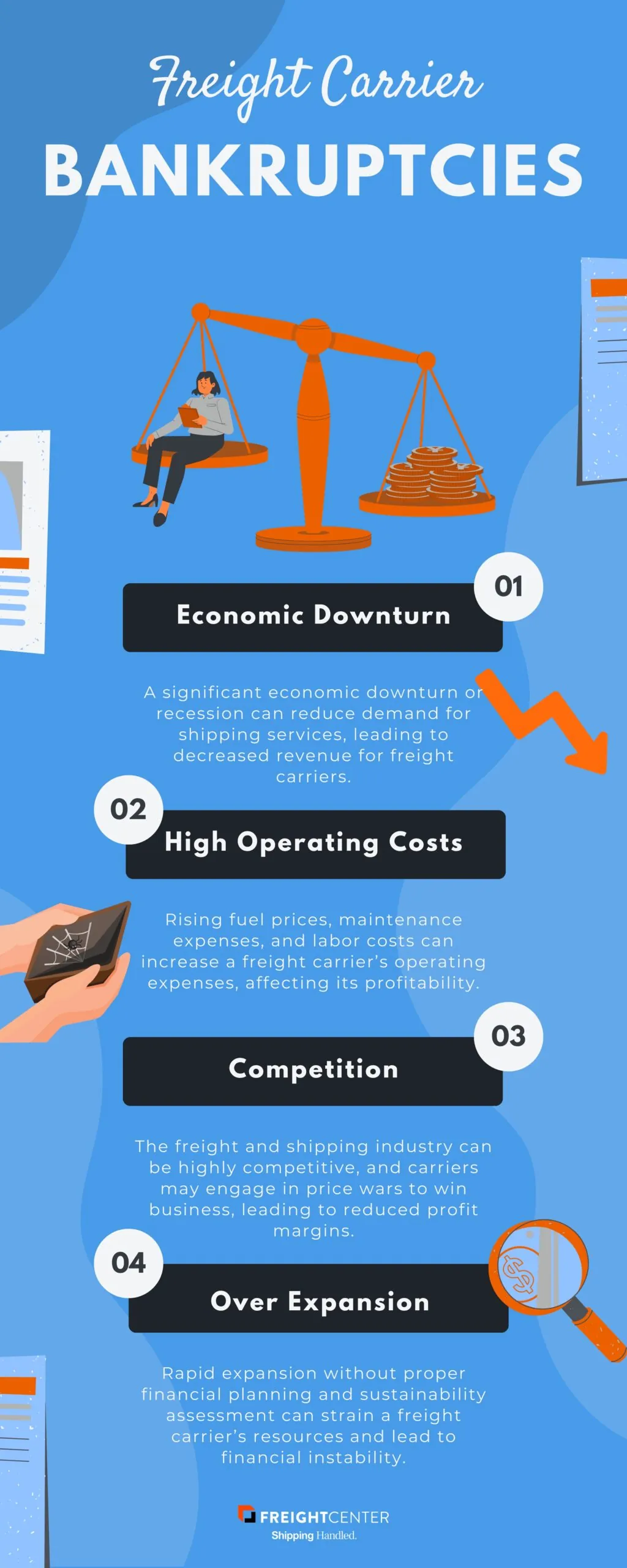
Freight carrier bankruptcies can be caused by various factors. One major cause is economic downturns. Businesses often cut back on their shipping needs when the economy struggles because they produce and sell less. This decrease in demand for transportation services can make it hard for freight carriers to cover their operating costs and stay profitable.
Another cause is high operating expenses. Running a freight carrier company involves many costs, including fuel, maintenance, labor, and insurance. If these costs rise significantly, it can pressure the company financially. For example, if fuel prices suddenly spike, it can dramatically increase expenses, making it difficult for the carrier to maintain profitability, especially if they cannot pass these costs onto their customers.
Competition within the freight industry is also a key factor. The freight market is highly competitive, with many companies vying for business. This competition can lead to lower shipping service prices as companies try to attract customers. While lower prices are reasonable for consumers, they can squeeze profit margins for carriers, making it harder for them to stay afloat. Smaller carriers, in particular, may struggle to compete with larger companies that have more resources and can offer lower rates.
Finally, poor management can contribute to freight carrier bankruptcies. Strategic decisions about routes, pricing, and investments are crucial for success in the freight industry. If a company makes poor choices, such as overextending its operations or failing to adapt to market changes, it can quickly find itself in financial trouble. Effective management is essential to navigating the industry’s challenges and maintaining a stable, profitable business.
How 3PLs Can Help
Alternative Carrier Options
3PLs typically have established relationships with multiple freight carriers. When one carrier goes bankrupt, the 3PL can quickly identify and arrange alternative carrier options to ensure the continuity of shipping services for its clients.
Network of Carriers
3PLs have extensive networks of freight carriers, ranging from small local carriers to large national or international carriers. This broad network allows them to tap into a pool of carriers with diverse capabilities, ensuring that suitable carriers can handle various shipping requirements.
Risk Diversification
By working with a 3PL, businesses can spread the risk of shipping among multiple carriers. If freight carrier bankruptcies occur, the impact on the business is less severe as the 3PL can redirect shipments to other carriers within their network.
Contractual Protections
Reputable 3PLs typically have well-structured contracts and agreements with carriers. These contracts often include clauses that safeguard the interests of their clients in the event of a carrier’s bankruptcy. The 3PL can navigate the legal aspects and potentially recover losses on behalf of its clients.
Supply Chain Continuity
When a carrier suddenly goes bankrupt, it can cause disruptions to the supply chain, affecting delivery timelines and inventory management. 3PLs can assess the situation, find alternative solutions, and work with other carriers to maintain the flow of goods and minimize disruptions.
Expertise in Logistics Management
3PLs are skilled in managing logistics operations efficiently. In case of a freight carrier’s bankruptcy, the 3PL can step up to handle logistics coordination, freight booking, tracking, and other aspects of transportation management that might otherwise cause challenges for the business.
Industry Knowledge
3PLs often have in-depth knowledge of the transportation industry. They stay updated with carrier performance, financial stability, and other relevant factors. As a result, they can make informed decisions regarding carrier selection and minimize the risk of partnering with carriers prone to financial instability.
Support in Claims Processing
In the unfortunate event of financial losses due to a carrier’s bankruptcy, the 3PL can assist its clients in the claims process, helping them recover losses through insurance or other means.
That’s why partnering with a 3PL like FreightCenter is the simplest way. We have active contracts with more than 45 LTL carriers. If one carrier should go bankrupt, it will not slow down our customers. We offer Full or Partial Truckload shipments, and we have hundreds of Truckload carriers and independent operators nationwide at our disposal.
When dealing directly with a carrier, the key is your contract. That’s all you have to rely on.
When partnering with a 3PL, there are several keys, including:
Experience | A startup 3PL may not have the relationships or resources to help you in a time of need.
Network | You need to be sure that the broker’s network can handle all of your needs, even in an emergency.
Status | If you’re an SMB and your 3PL deals primarily with enterprise-level shippers, it’s unlikely that you will be very important to them.
People | Having access to shipping experts and the ability to build a relationship with them can make all the difference in being a successful shipper.
FreightCenter has been serving SMB shippers for over 25 years, with an impressive network of truck carriers covering the entire U.S. and Canada. We want to be your shipping partner, and our staff of in-house shipping experts is ready to help.

Options for Freight Carrier Bankruptcies
When a freight carrier faces bankruptcy, a few key options are available to manage the situation. One common route is Chapter 11 bankruptcy, which allows the carrier to reorganize its debts and continue operating. This option enables the company to renegotiate contracts, reduce expenses, and hopefully return to profitability. It can be beneficial for preserving jobs and maintaining service for customers.
Another option is Chapter 7 bankruptcy, in which the carrier ceases operations and liquidates its assets to pay off creditors. This is typically seen as a last resort when the company cannot find a feasible path to recovery. In this scenario, assets such as trucks, warehouses, and other equipment are sold, and the proceeds are used to settle debts. Unfortunately, this option often results in job losses and disruption of services.
Lastly, there is the possibility of a merger or acquisition. Sometimes, a struggling freight carrier might be bought out by a healthier company. This can help save the business and retain jobs while the acquiring company benefits from expanded operations and assets. While not a guaranteed solution, it can be a strategic move to keep the carrier afloat and continue serving its customers.
Impact of Freight Carrier Bankruptcies

Freight carrier bankruptcies can have significant impacts on various parts of the economy. When a freight carrier goes bankrupt, it can cause disruptions in the supply chain. Businesses that rely on the carrier to transport goods might experience delays, leading to shortages of products in stores. This can affect everything from groceries to electronics, causing inconvenience for consumers and potentially raising prices.
Employees of the bankrupt freight carrier are also heavily impacted. Job losses are expected, leaving many workers without income and facing the challenge of finding new employment. This can be particularly difficult if the bankrupt carrier is a major employer in a small community. The loss of jobs affects the workers and the local economy, as less money is spent on local businesses and services.
Finally, a freight carrier’s bankruptcy can have ripple effects on other companies in the transportation and logistics industry. Competitors might see an increase in demand as they pick up the slack, but they might also face challenges like higher operating costs and the need to scale up operations quickly. Smaller carriers might struggle to compete with larger companies that can absorb the increased demand more efficiently. Overall, a freight carrier’s bankruptcy can create a complex web of economic consequences.
Shipping can be expensive and unpredictable. Compare the shipping rates and service options of different carriers to find the most cost-effective solution without compromising safety and reliability.
FreightCenter can compare costs for you!
Trucking is a popular mode of transportation for shipping pavers, especially for shorter distances or domestic shipments.
Trucks offer flexibility in terms of routes and delivery schedules, making them suitable for delivering large orders to construction sites, warehouses, or retail locations.
For international shipments or long-distance transportation across continents, ocean freight is commonly used. Bulk commodities are typically shipped in containers, either as full container loads (FCL) or less-than-container loads (LCL).
Air freight is the fastest mode of transportation, ideal for time-sensitive shipments or when immediate delivery is crucial. However, it is generally more expensive than other modes and may be less practical for large or heavy shipments.
Rail freight is an efficient option for shipping large quantities of pavers over long distances. Rail transport can handle heavy loads and is cost-effective for bulk shipments.
FTL stands for Full Truckload. In this shipping method, the entire available space in a truck is dedicated to a single shipment. When shipping pavers via FTL, the pavers will fill up the entire truck, and the shipment will not be shared with any other cargo from different customers.
LTL stands for Less-than-Truckload. In this shipping method, the truck's available space is shared by multiple shipments from different customers, including pavers from various suppliers. Each shipment is packed into separate pallets or crates and loaded together on the same truck.
Local deliveries for furniture and other home goods.
Impact on Customers

Freight carrier bankruptcies can significantly impact customers in various ways. One of the most immediate effects is the disruption in the delivery of goods. When a freight carrier goes bankrupt, shipments can be delayed or lost. This can create problems for businesses that depend on timely deliveries to keep their operations running smoothly. For example, a retail store might not receive its inventory on time, leading to empty shelves and lost sales.
Another impact is the potential increase in shipping costs. When a freight carrier exits the market due to bankruptcy, the remaining carriers may have to take on additional demand. This can increase prices as these companies adjust to the increased workload. For businesses that rely on shipping, these higher costs might be passed down to customers, resulting in more expensive products. This price increase can affect everyone, from large companies to individual consumers.
Freight carrier bankruptcies can also affect the quality of service. With fewer carriers available, the remaining companies might struggle to maintain high standards as they handle more shipments. This can lead to decreased service quality, such as longer delivery times, increased errors, and less reliable tracking information. These changes might frustrate customers who are used to quick and dependable shipping.
Additionally, customers might face difficulties finding alternative shipping options. Businesses might have to spend time and resources finding a suitable replacement if a bankrupt carrier was the primary provider for a particular region or specialized service. This process can be challenging and time-consuming, primarily if the remaining carriers operate at full capacity. The lack of readily available alternatives can disrupt business operations and lead to further delays.
The trust between businesses and their customers can be affected. When shipping becomes unreliable, customers might lose confidence in the businesses they purchase from. This loss of trust can decrease customer loyalty and negatively impact a company’s reputation. Businesses must work harder to reassure their customers and find reliable shipping solutions to maintain their trust and provide satisfactory service.
FreightCenter Makes Life Simple
There are several steps you can take to avoid problems with freight carrier bankruptcies and minimize potential disruptions in your shipments. At FreightCenter, we specialize in finding you the best carrier for your cargo and ensuring your cargo makes it to its destination on time.
1. Choose Reputable Carriers
Opt for well-established and reputable freight carriers with a proven track record of reliable service: research customer reviews and ratings to gauge the carrier’s performance and customer satisfaction. FreightCenter is focused on carrier options, and 3PLs can find new carriers with all available options.
2. Diversify Carrier Partnerships
Avoid relying solely on one freight carrier for all your shipments. Work with multiple carriers to spread the risk. If one carrier faces financial trouble, you have alternative options to fall back on.
3. Monitor Carrier Financial Health
Regularly check the financial health of the carriers you work with. Look for public financial reports or news articles that provide insights into their stability and financial performance.
4. Consider Shipping Insurance
Depending on the value of your shipments, consider purchasing shipping insurance. This type of insurance will provide financial protection if your goods are lost, damaged, or delayed due to carrier bankruptcy or other unforeseen events.
5. Stay Informed
Keep yourself updated on industry news and any developments related to the carriers you use. Be aware of any rumors or financial concerns that might indicate potential problems with a carrier.
6. Have a Contingency Plan
Develop a contingency plan in case your primary carrier encounters financial difficulties. Identify alternative carriers you can quickly switch to if needed.
7. Communicate with the Carrier
Establish good communication with the carrier’s customer service. If you have any concerns about a shipment or the carrier’s financial stability, reach out to them for reassurance and updates.
8. Utilize Package Tracking
Take advantage of package tracking services provided by the carrier. This will allow you to monitor your shipments’ progress and receive updates on any potential delays.
 Guaranteed competitive pricing every time you ship.

FreightCenter is Here For Your Shipment Needs!
The freight industry will always have ups and downs, but preparing for change is what keeps goods moving and customers satisfied. Freight carrier bankruptcies are disruptive, but they don’t have to bring your supply chain to a halt. With FreightCenter, you get more than just a quote. You get a freight partner with over 25 years of experience that understands the complexity of the freight industry and can help navigate your shipment every step of the way.
Let’s make sure your shipment gets the treatment it deserves. Get your shipping quote today or call us at (800) 716-7608.
FAQ: Freight Carrier Bankruptcies

Q. How common are freight carrier bankruptcies?
They tend to rise during market downturns when demand slows and costs remain high. The trucking industry is highly competitive, so closures and bankruptcies happen every year, even among mid-size and large carriers.
Q. How can I tell if my carrier might be at risk of bankruptcy?
There are usually early warning signs that a carrier may be in financial trouble. These can include reports of missed driver paychecks, delays in vendor payments, sudden service cuts, or aggressive rate changes that seem unsustainable. Industry news about lawsuits, facility closures, or mass layoffs should also be taken seriously, as they often precede larger financial problems. Monitoring these signs can help shippers prepare alternatives before a shutdown occurs.
Q. What happens to freight already in transit if a carrier files for bankruptcy?
When a carrier files for bankruptcy, freight that is already moving through their network can be left in limbo. Some companies attempt to complete deliveries before shutting down, while others halt operations immediately, which can leave shipments stranded at terminals or inside trailers. In those cases, shippers often need to work with brokers, alternative carriers, or even legal representatives to retrieve goods.
Q. What’s the impact of a carrier bankruptcy on shippers?
For shippers, a bankruptcy can cause freight disruptions, stranded shipments, and financial uncertainty. In the short term, shipments may be delayed or canceled altogether, which can damage relationships with customers who depend on timely deliveries. In the longer term, capacity may tighten across the market, leading to higher rates and fewer carrier options, especially in regions where the bankrupt carrier was a dominant player.
Q. Do bankrupt carriers ever resume operations?
Some carriers attempt to restructure under Chapter 11 bankruptcy, which allows them to continue limited operations while reorganizing their debt. However, many file under Chapter 7, which involves liquidation and a complete shutdown of the business. Restructuring is difficult in such a competitive industry, so the majority of carriers that file for bankruptcy ultimately cease operations permanently.
Q. Can I recover freight costs if my carrier goes bankrupt?
It is sometimes possible, but recovering money after a carrier bankruptcy can be challenging. Shippers typically need to file claims through bankruptcy court, and recovery depends on whether the company has enough assets left to distribute after paying higher-priority creditors. In many cases, shippers only receive partial compensation or none at all, which is why preventive measures like cargo insurance and diversification are so important.
Q. Does carrier bankruptcy affect freight rates across the industry?
Yes, especially when the bankrupt carrier was large enough to impact national or regional capacity. When a significant amount of capacity is suddenly removed from the market, other carriers absorb the excess demand, and rates rise accordingly. Even smaller bankruptcies can lead to higher prices in certain lanes or regions, as shippers compete for fewer available trucks.
Q. Are smaller carriers more likely to file for bankruptcy than large ones?
Smaller carriers may lack financial reserves, making them more vulnerable to fuel price spikes, sudden demand drops, or regulatory costs. However, history shows that even some of the largest carriers have filed for bankruptcy when burdened with heavy debt or poor financial management. Size alone does not guarantee safety; operational efficiency, debt load, and adaptability to market conditions are often more important.
Q. Can freight insurance protect me if my carrier goes bankrupt?
Cargo insurance typically covers physical loss or damage to goods, not financial loss due to a carrier’s insolvency. That said, if freight is stranded and eventually declared lost, insurance may help cover the cargo’s value. To protect against the financial fallout of bankruptcies more broadly, shippers rely on diversification, strong contracts, and working with brokers who can shift freight to alternate carriers.
Q. What’s the difference between a carrier bankruptcy and a carrier closure?
A bankruptcy involves formal legal proceedings, either to liquidate assets (Chapter 7) or to restructure debts (Chapter 11). A closure, on the other hand, may simply mean the carrier shuts down operations without going through bankruptcy court, often leaving less transparency for shippers trying to recover freight or money owed. Both cause disruption, but bankruptcies usually involve more complexity due to legal processes.
Q. Can shippers prepare in advance for potential bankruptcies?
Yes, and preparation is key. Shippers can diversify their carrier base to avoid reliance on one provider, maintain relationships with brokers or 3PLs who can step in quickly, and carry insurance to reduce exposure to losses. Staying informed about industry news, financial reports, and operational changes at carriers also provides valuable early warnings.
Q. How quickly can a carrier go from operating to bankrupt?
The shift can be surprisingly fast. Some carriers announce a shutdown overnight, leaving shippers and drivers shocked, while others show signs of financial decline for months before finally filing. Because of the tight margins in trucking, once a carrier runs out of cash flow, the end can come almost immediately.
Q. Are international carriers at risk of bankruptcy, too?
Yes, freight carriers in every mode—whether trucking, ocean, or air—are subject to bankruptcy risks. International carriers face added challenges from global trade fluctuations, currency shifts, tariffs, and fuel costs, which can make them vulnerable even when demand is steady. Shippers relying on international freight need to watch these risks closely and diversify globally as well as domestically.
Q. What’s the best long-term strategy for shippers concerned about bankruptcies?
The most effective approach is to build resilience into your supply chain. That means using a mix of carriers instead of depending on a single partner, working with brokers or 3PLs who have broad networks, carrying insurance to reduce financial exposure, and maintaining contingency plans for rerouting freight. By spreading risk and preparing in advance, shippers can keep goods moving even if a carrier suddenly shuts its doors.
Q. What if I need help figuring out the best carrier for my shipping needs?
That’s what we’re here for! Tell us what you’re shipping, where it’s going, and how fast you need it there, and we’ll help you find the best carrier for you. Call us at (800) 716-7608 or use our quote tool—we’ll guide you through it every step of the way.
3 Tips for Safer Freight Shipping
Diversify Your Carrier Network
Relying on a single carrier is risky, especially in today’s volatile freight market. Spread your freight across several carriers so you have options if one shuts down. Think of it as building flexibility into your supply chain.

Don’t Ship Without Insurance—Ever
Carriers typically cover only $0.10–$0.50 per pound. That won’t even come close to replacing your merchandise. With our 3rd-party shipment protection options, you'll get the full value of your cargo and ensure peace of mind for your shipment.

Build Contingency Plans in Advance
Don’t wait for a crisis to figure out your next move. Create routing guides that list secondary carriers, outline processes for recovering freight, and include emergency contacts. Having a plan in place shortens response time when disruptions hit.